

eVisa vs Visa on Arrival in Guinea: Which Is Better?
The Guinea eVisa is the better option for nearly every traveler. While Guinea technically offers a visa on arrival, it is restricted almost exclusively to UAE nationals. The eVisa, available through the official portal at paf.gov.gn/visa, provides pre-travel approval for all nationalities, eliminates airline boarding risks, and costs the same $80 USD as the tourist visa on arrival. For anyone who is not a UAE citizen, the eVisa is not just the better choice – it is the only choice.
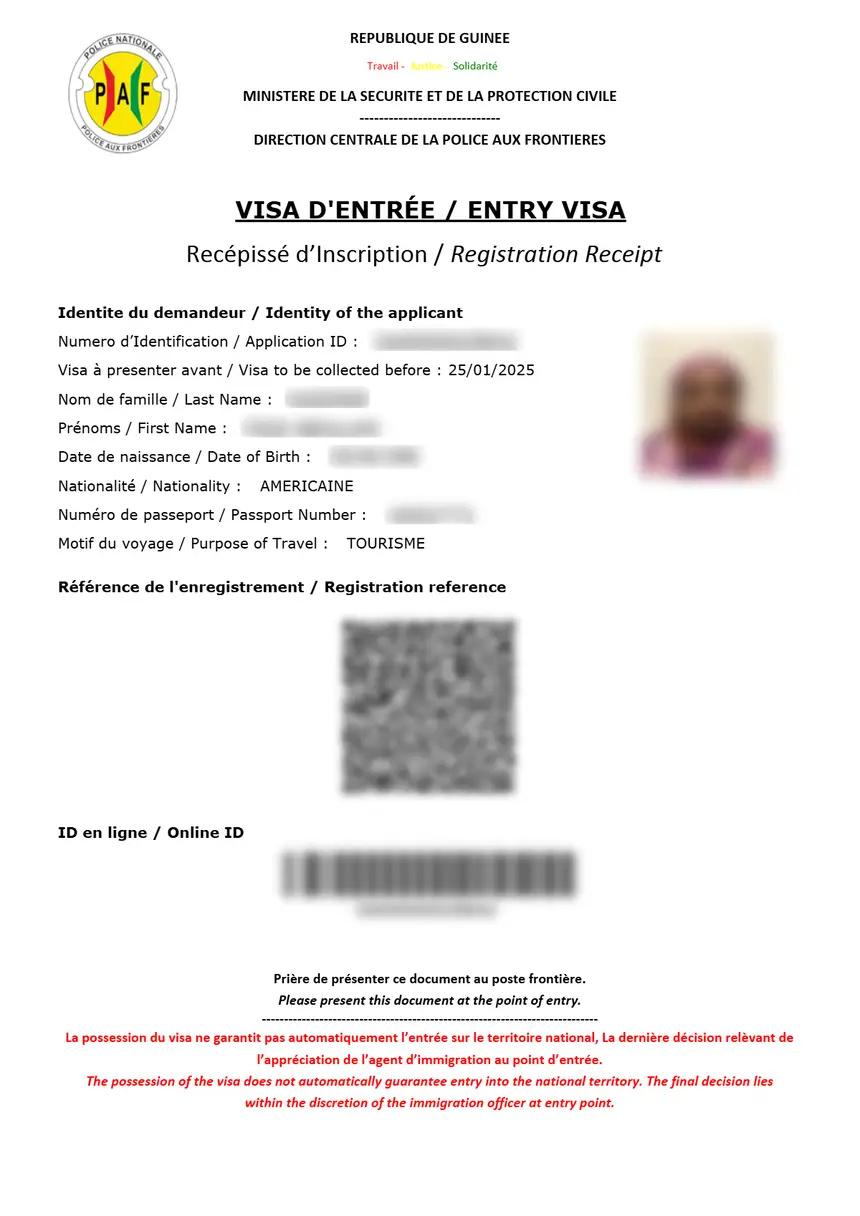
This guide compares both options side by side so you can understand the differences in eligibility, cost, processing time, risk, and convenience before your trip to Guinea.
Quick Comparison Table
| Feature | Guinea eVisa | Guinea Visa on Arrival |
|---|---|---|
| **Eligibility** | All nationalities requiring a visa | UAE nationals only |
| **When to apply** | Before departure (online) | At the airport after landing |
| **Processing time** | 3-4 business days | On the spot (variable) |
| **Fee** | $80 USD (tourist) | ~$80 USD (tourist) |
| **Payment method** | Credit/debit card online | Often cash only (USD or GNF) |
| **Pre-approval** | Yes – Entry Visa Letter issued | No – decision at the airport |
| **Airline acceptance** | Fully accepted worldwide | May cause boarding issues |
| **Risk of denial** | Low – approved before travel | Higher – officer discretion |
| **Entry points** | Conakry airport + select borders | Conakry airport only |
| **Recommendation** | **Strongly recommended** | Only if no other option |
What Is the Guinea eVisa?
The Guinea eVisa is an electronic visa that travelers apply for online before their trip. The system is managed by the Police de l’Air des Frontieres (PAF) through the official portal at paf.gov.gn/visa. Once approved, you receive an Entry Visa Letter via email that you print and carry with your passport.
The eVisa covers all standard visa categories:
| Visa Type | Fee (USD) | Duration |
|---|---|---|
| Tourist (single entry) | $80 | Up to 90 days |
| Transit | $50 | Up to 3 days |
| Business | $100 | Varies |
| Long-term | $150 | Up to 1 year |
The application process is fully digital. You create an account, fill out the form, upload your documents (passport scan, photo, yellow fever certificate, flight itinerary, proof of accommodation), pay by card, and wait 3-4 business days for a decision. For a step-by-step walkthrough, see our How to Apply for Guinea eVisa guide.
What Is the Guinea Visa on Arrival?
A visa on arrival (VOA) is a visa issued at the airport when you land, rather than obtained before departure. In Guinea, this option exists at Conakry International Airport (CKY) but comes with a critical restriction: only UAE nationals are eligible.
If you hold a passport from the United States, United Kingdom, India, France, China, Nigeria (for non-ECOWAS purposes), or any other non-UAE country, the visa on arrival is not available to you. Airlines flying to Conakry will check for visa documentation before allowing you to board, and without a pre-approved eVisa Entry Visa Letter, you will likely be denied boarding at your departure airport.
Key Differences Explained
Eligibility
This is the most important difference. The eVisa is open to citizens of every country that requires a visa for Guinea. The visa on arrival is limited to UAE passport holders only. ECOWAS citizens (Nigeria, Senegal, Mali, Ivory Coast, Ghana, and others) do not need either option – they enter visa-free with an ECOWAS passport. Citizens of Algeria, Cuba, Morocco, Tunisia, Turkey, South Africa, and Rwanda also enjoy visa-free entry.
For a full list of visa-free nationalities, see our Guinea Visa complete guide.
Processing Time
The eVisa takes 3-4 business days to process, though it can extend to 5-7 days during peak travel season (November to February). You apply well in advance and have your approval before you even pack your bags.
The visa on arrival is processed on the spot at the airport. In theory, this sounds faster. In practice, you may face long queues at the VOA counter, especially when multiple international flights land around the same time. The actual processing time depends on the immigration officer’s workload and the completeness of your documentation.
Cost and Payment
Both options cost approximately the same – $80 USD for a tourist visa. The critical difference is how you pay:
- eVisa: Paid online by credit or debit card during the application. Secure, traceable, no cash needed.
- Visa on arrival: Often requires cash payment in USD or Guinean Franc (GNF). ATMs at Conakry airport may not always work, and exact change may be required.
Risk and Certainty
This is where the eVisa pulls decisively ahead. With an eVisa, you know your visa is approved before you leave home. The Entry Visa Letter is your proof. Airlines accept it without question. Immigration officers at Conakry verify it and stamp your passport.
With a visa on arrival, you have no advance guarantee. You fly to Guinea not knowing whether your visa will be approved. If the immigration officer finds an issue with your documents, you could be denied entry and placed on a return flight. Airlines are also fined for transporting passengers without proper visas, so they actively check documentation at departure – meaning you might not even make it to Guinea.
Convenience
The eVisa process happens entirely from your computer or phone. No standing in queues, no filling out paper forms at 2 AM after a long flight, no scrambling for cash at the airport. You arrive at Conakry with your printed Entry Visa Letter, walk through immigration smoothly, and start your trip.
The visa on arrival requires you to fill out forms at the counter, present physical documents, wait for processing, and pay in cash. This adds 30-60 minutes to your arrival experience, and potentially much longer during busy periods.
Who Should Use Each Option?
Use the eVisa if:
- You are a citizen of any country requiring a visa for Guinea (US, UK, India, France, China, etc.)
- You want guaranteed entry approval before traveling
- You prefer paying by card rather than carrying cash
- You want to avoid airport queues and uncertainty
- You are traveling during peak season when processing may be slower
Consider visa on arrival if:
- You are a UAE national
- You had a last-minute trip and did not have time to apply for an eVisa
- You understand and accept the risks of no pre-approval
Even for UAE nationals, the eVisa is still the recommended option. The peace of mind alone is worth the 3-4 day wait.
How to Apply for the Guinea eVisa
The process is straightforward:
- Visit paf.gov.gn/visa (the official PAF portal)
- Create an account with your email address
- Complete the form with your personal and travel details
- Upload documents – passport scan, photo, yellow fever certificate, flight itinerary, proof of accommodation
- Pay the fee – $80 USD for tourist visa by card
- Wait – 3-4 business days for processing
- Print your Entry Visa Letter and carry it with your passport
For detailed instructions with screenshots, see our Guinea Visa Application guide. If you need to check your application status after submitting, our application status guide explains how.
What You Need for Either Option
Whether you apply for an eVisa or (if eligible) use the visa on arrival, you need the same core documents:
- Valid passport – at least 6 months validity from your entry date
- Yellow fever vaccination certificate – mandatory for all travelers entering Guinea
- Passport-style photograph
- Flight itinerary – return or onward ticket
- Proof of accommodation – hotel booking or host invitation letter
The eVisa application verifies these documents in advance. If anything is missing or unclear, you are notified and can fix the issue before departure. With a visa on arrival, document problems are discovered at the worst possible moment – when you have already landed in Conakry. For a complete document checklist, see our Guinea Visa Requirements page.
Common Mistakes to Avoid
Showing up without a visa assuming you can get one at the airport. This is the most common and most costly mistake. Unless you are a UAE national or from a visa-free country, you will be denied entry. Airlines will likely prevent you from boarding in the first place.
Applying too late. The eVisa takes 3-4 business days, but during peak season it can take 5-7. Apply at least two weeks before your trip to be safe. For current processing times, check our Guinea eVisa Processing Time guide.
Forgetting the yellow fever certificate. This is required for all travelers, regardless of visa type or nationality. Guinea is in the yellow fever belt, and the vaccination is mandatory. Without it, you will be denied entry even with a valid visa.
Carrying insufficient cash for VOA. If you are a UAE national using the visa on arrival, bring enough USD cash to cover the fee. Airport ATMs may not work, and credit card payment is typically not accepted at the VOA counter.
FAQs About eVisa vs Visa on Arrival in Guinea
Can I choose between eVisa and visa on arrival when I arrive in Guinea?
No. If you are not a UAE national, the visa on arrival is not available to you. You must apply for the eVisa before departure. There is no choice to make at the airport – you either have a pre-approved eVisa or you are from a visa-free country, or you will be denied entry.
Is the Guinea eVisa more expensive than the visa on arrival?
No. Both cost approximately $80 USD for a tourist visa. The eVisa fee is paid online by card, while the visa on arrival fee is typically paid in cash at the airport. The eVisa is actually more cost-effective because you avoid potential currency exchange fees and the risk of not having exact change.
Can US citizens get a visa on arrival in Guinea?
No. US citizens must apply for a Guinea eVisa before travel. The tourist eVisa costs $80 USD and takes 3-4 business days to process. You will also need a yellow fever vaccination certificate. See our complete Guinea Visa for US Citizens guide for details.
What happens if I arrive in Guinea without a visa and I am not from a visa-free country?
You will be denied entry and placed on a return flight. Airlines are fined for transporting passengers without proper documentation, so they actively check visa status before boarding. This means you are very likely to be stopped at your departure airport, not just upon arrival in Conakry.
How far in advance should I apply for the Guinea eVisa?
Apply at least two weeks before your trip. Standard processing takes 3-4 business days, but during peak travel season (November to February) it can take 5-7 days. Applying early gives you time to resolve any issues if your documents need corrections.
Is the eVisa accepted at all entry points in Guinea?
The eVisa is primarily processed at Conakry International Airport (CKY). If you are entering through a land border crossing, confirm in advance that the eVisa is accepted at your specific crossing point. Some remote border posts may have limited processing capability.
Do ECOWAS citizens need an eVisa or visa on arrival?
No. Citizens of ECOWAS member states (Nigeria, Senegal, Mali, Ivory Coast, Ghana, Burkina Faso, Togo, Benin, Sierra Leone, Liberia, Gambia, Guinea-Bissau, Niger, Cape Verde) can enter Guinea visa-free with a valid ECOWAS passport and a yellow fever vaccination certificate.
Can I extend my Guinea eVisa once I am in the country?
Visa extensions may be possible through the immigration office in Conakry, but this is not guaranteed and is handled on a case-by-case basis. It is better to apply for the visa duration you need from the start. If you need a longer stay, consider the long-term visa ($150 USD, up to 1 year).
Final Verdict
For every traveler who is not a UAE national, the Guinea eVisa is the only viable option and the clearly superior choice. It costs the same as the visa on arrival, provides guaranteed pre-approval, eliminates airline boarding risks, and makes your arrival in Conakry smooth and predictable.
Even if you are a UAE national eligible for the visa on arrival, the eVisa is still the better choice. The certainty of having your visa approved before you fly, the convenience of online payment, and the faster immigration processing make it worth the 3-4 day wait.
Apply for your Guinea eVisa at paf.gov.gn/visa at least two weeks before your trip. Print your Entry Visa Letter, pack your yellow fever certificate, and travel with confidence.
This article was last updated in 2026. Visa policies can change without notice. Always verify the latest requirements at the official Guinea eVisa portal before traveling.