

Guinea Visa Policy: Complete Overview (2026)
Guinea’s visa policy determines who can enter the country, for how long, and through what process. Understanding this policy is essential before booking flights or planning any trip to Conakry or other Guinean destinations. This guide breaks down every aspect of the Guinea visa policy – from visa-free arrangements and the electronic visa system to entry requirements that apply to every traveler regardless of nationality.
Whether you are a tourist heading to the Fouta Djallon highlands, a business traveler attending meetings in Conakry, or a transit passenger connecting through Guinea to another West African country, the information below will help you determine exactly what you need to enter the country legally and without complications.
Overview of Guinea’s Visa Policy
Guinea operates a visa-required policy for the majority of foreign nationals. Unlike some countries that offer visa-free access to a broad range of passport holders, Guinea restricts visa-free entry primarily to citizens of ECOWAS member states and a handful of countries with bilateral agreements.
For everyone else, the government has implemented an electronic visa (e-Visa) system through the Guinea Border Police (Police de l’Air, des Frontières et des Émigrations – PAF). The official portal is paf.gov.gn/visa, and it serves as the primary method for obtaining a visa before travel.
Key elements of Guinea’s current visa policy:
- Visa-free entry for ECOWAS nationals and select bilateral agreement countries
- e-Visa as the standard visa application method for all other nationalities
- Visa on arrival available only to UAE nationals (extremely limited)
- Yellow fever vaccination mandatory for all travelers regardless of nationality
- Passport validity of at least 6 months required from date of entry
- No embassy visa required – the e-Visa system has replaced in-person applications for most travelers
The policy is enforced at all ports of entry, including Conakry International Airport (CKY), land borders with Senegal, Mali, Sierra Leone, Liberia, Ivory Coast, and Guinea-Bissau, and maritime entry points.
Who Can Enter Guinea Without a Visa?
Guinea grants visa-free entry to citizens of certain countries and regional blocs. If you hold a passport from one of these nations, you do not need to apply for any visa before traveling.
ECOWAS Member States
The most significant visa-free arrangement comes through the Economic Community of West African States (ECOWAS). Citizens of all 15 ECOWAS member states can enter Guinea without a visa using a valid national ID card or ECOWAS passport:
| Country | Visa-Free? | Maximum Stay | Document Required |
|---|---|---|---|
| Nigeria | Yes | 90 days | ECOWAS passport or national ID |
| Senegal | Yes | 90 days | ECOWAS passport or national ID |
| Ghana | Yes | 90 days | ECOWAS passport or national ID |
| Mali | Yes | 90 days | ECOWAS passport or national ID |
| Ivory Coast | Yes | 90 days | ECOWAS passport or national ID |
| Burkina Faso | Yes | 90 days | ECOWAS passport or national ID |
| Sierra Leone | Yes | 90 days | ECOWAS passport or national ID |
| Liberia | Yes | 90 days | ECOWAS passport or national ID |
| Togo | Yes | 90 days | ECOWAS passport or national ID |
| Benin | Yes | 90 days | ECOWAS passport or national ID |
| Niger | Yes | 90 days | ECOWAS passport or national ID |
| Gambia | Yes | 90 days | ECOWAS passport or national ID |
| Guinea-Bissau | Yes | 90 days | ECOWAS passport or national ID |
| Cape Verde | Yes | 90 days | ECOWAS passport or national ID |
ECOWAS nationals still need to carry a valid yellow fever vaccination certificate when entering Guinea. This is a health requirement, not a visa requirement, and it applies to everyone.
Other Visa-Free Agreements
Beyond ECOWAS, Guinea maintains bilateral visa-free arrangements with several other countries. Citizens of these nations can also enter without a visa for short stays:
- Algeria – up to 90 days
- Cuba – up to 90 days
- Morocco – visa-free arrangement
- Tunisia – visa-free arrangement
- Turkey – visa-free arrangement
- South Africa – visa-free arrangement
- Rwanda – visa-free arrangement
- United Arab Emirates – visa-free plus visa on arrival available
These agreements are subject to change based on diplomatic relations. If you hold a passport from one of these countries, verify the current arrangement before booking travel.
For the complete and up-to-date list, see our guide on Guinea visa-free countries.
The Guinea e-Visa System
For the vast majority of international travelers – including citizens of the United States, United Kingdom, European Union, Canada, Australia, India, China, Japan, and most other countries – the e-Visa is the standard way to obtain entry authorization for Guinea.
The e-Visa replaced the previous system where travelers had to visit a Guinea embassy or consulate in person. Since many countries had no Guinea diplomatic mission, this old system created significant inconvenience. The electronic system eliminates that barrier entirely.
How the e-Visa works:
- Apply online at paf.gov.gn/visa
- Upload required documents (passport scan, photo, yellow fever certificate, proof of accommodation)
- Pay the fee by credit or debit card ($80 USD for tourist, $50 USD for transit, $150 USD for long-term)
- Wait 3 to 4 business days for processing
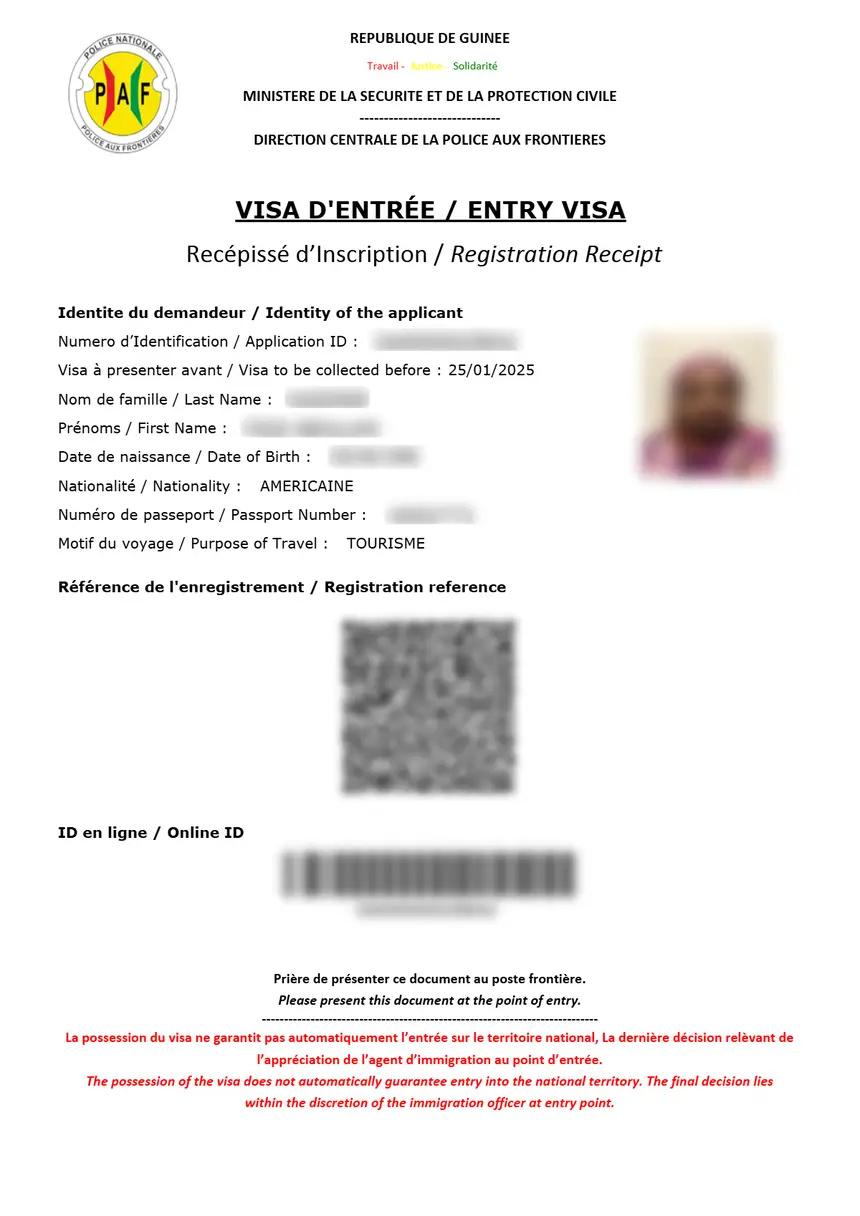
- Receive an Entry Visa Letter by email
- Print the letter and present it upon arrival in Guinea
- Immigration stamps the actual visa into your passport at the port of entry
The e-Visa is not a visa stamp itself – it is a pre-travel authorization. The physical visa is issued when you arrive in Guinea. This is an important distinction: you must carry the printed Entry Visa Letter with you when you travel.
For the step-by-step application guide, see how to apply for a Guinea e-Visa.
Visa on Arrival Policy
Guinea technically offers a visa on arrival (VOA), but the policy is extremely limited. Only UAE nationals are eligible for this option. No other nationality can reliably obtain a visa at the airport.
This means you should not plan on getting a visa when you land in Conakry unless you hold a UAE passport. Airlines serving Guinea will check for visa documentation before boarding, and without an Entry Visa Letter or proof of visa-free eligibility, you will likely be denied boarding.
Even for UAE nationals, the e-Visa is the recommended route because it provides:
- Pre-travel certainty – you know your visa is approved before you fly
- No airport queues – bypass the visa on arrival counter
- Airline acceptance – no risk of boarding issues
- Faster immigration processing – your details are already in the system
For a detailed comparison, read Guinea visa on arrival vs e-Visa.
Key Entry Requirements for All Travelers
Regardless of whether you need a visa or qualify for visa-free entry, certain entry requirements apply to every traveler entering Guinea.
Passport Validity
Your passport must be valid for at least 6 months from your date of entry into Guinea. This is strictly enforced. If your passport expires within 6 months of your arrival date, you will be denied entry – even if you hold a valid visa.
Additionally, your passport should have at least 2 blank pages for entry and exit stamps. Travelers with full passports have been turned away at the border.
Yellow Fever Vaccination
A yellow fever vaccination certificate (International Certificate of Vaccination – the yellow card) is mandatory for all travelers entering Guinea. This requirement exists because Guinea is located in the yellow fever endemic zone of West Africa.
Key details about the yellow fever requirement:
- You must be vaccinated at least 10 days before arrival for the vaccine to be considered effective
- The certificate is checked at the port of entry – either at the airport immigration counter or at land borders
- Children under 9 months are exempt in some cases, but check current regulations
- There is no exemption based on nationality or visa type
If you arrive without a valid yellow fever certificate, you may be vaccinated on the spot at the airport (if supplies are available) or denied entry.
For more details, see our guide on Guinea visa requirements.
Proof of Accommodation and Onward Travel
Immigration officers may ask for:
- Hotel reservation or invitation letter from a host in Guinea
- Return or onward flight ticket showing you plan to leave within your visa validity period
- Proof of sufficient funds for your stay (bank statement or cash)
While these are not always checked at every entry point, having them ready avoids delays and potential issues.
Guinea Visa Policy by Nationality
Here is a quick-reference summary of Guinea’s visa policy for the most common nationalities:
| Nationality | Visa Required? | Method | Fee (USD) |
|---|---|---|---|
| United States | Yes | e-Visa | $80 |
| United Kingdom | Yes | e-Visa | $80 |
| European Union | Yes | e-Visa | $80 |
| Canada | Yes | e-Visa | $80 |
| Australia | Yes | e-Visa | $80 |
| India | Yes | e-Visa | $80 |
| China | Yes | e-Visa | $80 |
| Nigeria | No (ECOWAS) | Visa-free | – |
| Senegal | No (ECOWAS) | Visa-free | – |
| Ghana | No (ECOWAS) | Visa-free | – |
| UAE | No | Visa-free / VOA | – |
| Algeria | No | Visa-free | – |
For country-specific guidance, see our dedicated guides for US citizens and other nationalities.
Recent Changes to Guinea’s Visa Policy
Guinea’s visa policy has evolved significantly in recent years. The most notable changes include:
- Introduction of the e-Visa system – The shift from embassy-based applications to the online portal at paf.gov.gn/visa has been the biggest policy change. This made Guinea accessible to travelers in countries without a Guinea embassy.
- Digitalization of border control – Entry and exit records are now digitized, making it easier to track overstay violations.
- Stricter enforcement of health requirements – The yellow fever certificate check has become more rigorous at all ports of entry, including land borders where it was previously inconsistently enforced.
- Fee adjustments – Visa fees have been periodically updated. Always check the official portal for the most current pricing.
Guinea’s visa policy continues to develop as the country modernizes its border infrastructure and expands diplomatic agreements. Travelers should verify current requirements on the official portal or with the nearest Guinea embassy before making travel plans.
Frequently Asked Questions
Do US citizens need a visa for Guinea?
Yes. US citizens must apply for an e-Visa before traveling to Guinea. There is no visa-free arrangement between the United States and Guinea. The standard tourist e-Visa costs $80 USD and allows a stay of up to 90 days. Apply at paf.gov.gn/visa.
Which countries are visa-free for Guinea?
ECOWAS member states (Nigeria, Senegal, Ghana, Mali, Ivory Coast, Burkina Faso, and others) enjoy visa-free entry to Guinea. Additionally, Algeria, Cuba, Morocco, Tunisia, Turkey, South Africa, Rwanda, and the UAE have bilateral visa-free arrangements. All other nationalities require a visa.
What is the difference between a Guinea visa and a Guinea e-Visa?
They are the same thing in practice. The e-Visa is the application method – you apply online and receive an Entry Visa Letter by email. The actual visa stamp is placed in your passport when you arrive in Guinea. The term “e-Visa” refers to the electronic application process, not a separate visa category.
Can I get a Guinea visa at the airport?
Only UAE nationals can get a visa on arrival in Guinea. All other travelers who need a visa must apply for the e-Visa online before departure. Do not plan on getting a visa at the airport – airlines will check for visa documentation before allowing you to board.
How long does it take to get a Guinea visa?
The e-Visa processing time is typically 3 to 4 business days. During peak travel seasons or national holidays, processing may take longer. It is recommended to apply at least 2 weeks before your intended travel date to allow for any delays.
Is the yellow fever vaccine required for Guinea?
Yes. A valid yellow fever vaccination certificate is mandatory for all travelers entering Guinea, regardless of nationality or visa status. You must be vaccinated at least 10 days before arrival. The certificate is checked at the port of entry.
How much does a Guinea visa cost?
The Guinea tourist e-Visa costs $80 USD. A transit visa costs $50 USD, and a long-term visa (up to 1 year) costs $150 USD. Fees are paid online by credit or debit card during the application process. For a full breakdown, see our Guinea visa fee guide.
What happens if I overstay my Guinea visa?
Overstaying a visa in Guinea can result in fines, detention, and deportation. It may also affect your ability to obtain future visas for Guinea or other West African countries. If you need to extend your stay, contact the immigration authorities in Conakry before your visa expires.